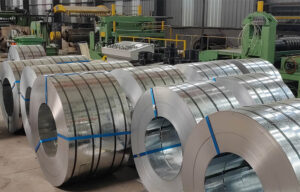
 Galvanized Coils (Sheets/Strips)
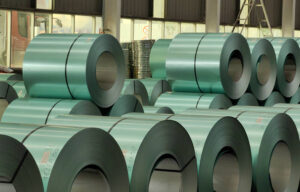 Galvalume Coils (Sheets/Strips)
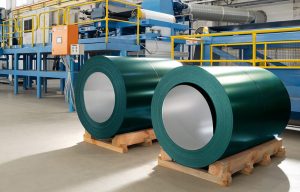 PPGI/PPGL Coils
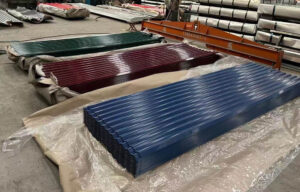 Corrugated Roofing sheets
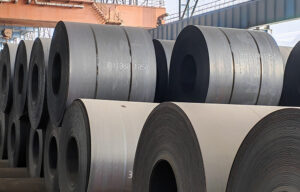 Hot Rolled Coils (Sheets/Strips)
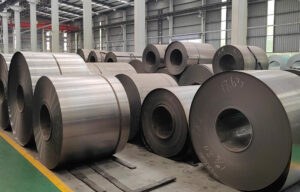 Cold Rolled Coils (Sheets/Strips)
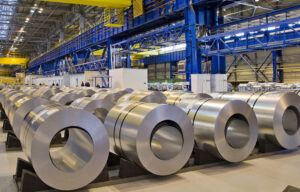 Aluminum Coils (Sheets)
 Tinplate Coils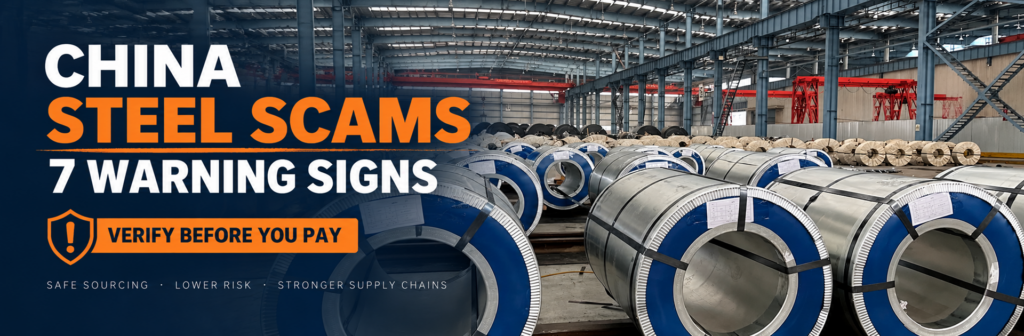
China steel scams are a growing concern for international buyers sourcing steel from unfamiliar suppliers. An unusually low price may look attractive, but it can sometimes hide serious risks involving payment, delivery, quantity, or product quality.
Buying steel from China can offer significant advantages in price, product range, manufacturing capacity, and supply-chain flexibility.
But international steel trading is also a business involving large transaction values, technical specifications, advance payments, and long-distance delivery.
That combination creates risk.
Price competition is intense, and it is perfectly normal for quotations to vary between suppliers. Different mills, inventory positions, purchasing channels, payment terms, specifications, order volumes, and delivery schedules can all affect the final price.
However, when one supplier offers steel consistently and significantly below the prevailing market level, while also showing unusual payment arrangements, vague contracts, unverifiable factory claims, hidden company controllers, or aggressive pressure for a deposit, buyers should become much more cautious.factory claims, hidde
At that point, the question may no longer be:
“Why is this supplier cheaper?”
The more important question becomes:
“What risk is hidden behind this price?”
As a company based in one of China’s major steel-producing regions, we have seen and heard many cases in which overseas buyers suffered serious losses when sourcing steel from unfamiliar suppliers.
The details may differ, but many high-risk transactions follow surprisingly similar patterns. Understanding how China steel scams typically work can help overseas buyers recognize warning signs before making a deposit.
This guide does not attempt to label any specific company, city, bank, or individual as fraudulent. Instead, it provides overseas steel buyers with a practical framework for identifying warning signs before making payment.
7 Warning Signs of a High-Risk Steel Supplier
1. The Company Looks Large Online, but Its Real Operations Cannot Be Verified
A supplier’s website may look extremely professional.
You may see:
- large factory buildings,
- production lines,
- warehouses,
- loading photos,
- certificates,
- export cases,
- quality-control claims,
- and impressive company profiles.
Its registration documents may also show high registered capital and a long business history.
But independent verification may reveal that the company operates from only a few office rooms and does not actually own the factory, warehouse, equipment, or inventory shown in its marketing materials.
This does not mean that every trading company is risky.
Many legitimate steel traders do not own factories. They operate successfully through long-term relationships with steel mills, processors, and logistics providers.
The real warning sign is this:
A company claims to be a manufacturer but cannot independently prove its manufacturing capability.
If a supplier says it owns a factory, buyers should be able to verify:
- factory address,
- production equipment,
- workshop activity,
- actual employees,
- raw material inventory,
- production records,
- and the relationship between the factory and the contracting company.
A business license proves that a company exists.
It does not prove that the company owns the factory it claims to own.
Verify the operation, not just the registration.
2. The Price Is Far Below the Market — but Nobody Can Explain Why
This is one of the most important warning signs in steel sourcing.
Steel is a highly transparent commodity market.
Products such as:
- hot rolled coil,
- cold rolled coil,
- galvanized steel,
- galvalume steel,
- PPGI,
- steel plate,
- H-beams,
- steel sections,
- and steel pipes
all have relatively clear cost structures.
Of course, legitimate price differences exist.
A lower price may come from:
- direct mill allocation,
- old inventory,
- larger order volume,
- different steel grade,
- wider tolerance,
- shorter payment terms,
- secondary material,
- or temporary stock clearance.
But a large price difference should have a reasonable commercial explanation.
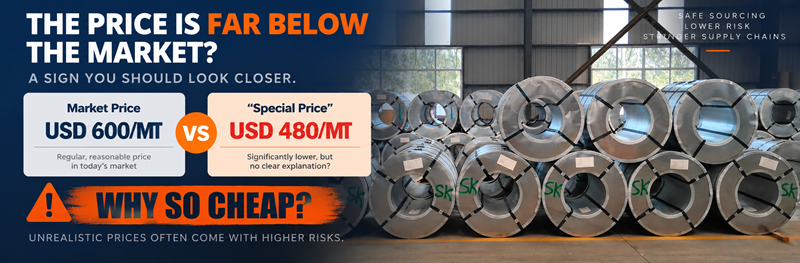
For example, if the prevailing market price is around:
USD 600/MT
and one supplier suddenly offers:
USD 520/MT, USD 500/MT, or even USD 480/MT
while still promising unusually high commissions to agents or intermediaries, buyers should stop and ask:
Where does the profit come from?
If the supplier appears to be selling below normal procurement cost while still paying commissions and operating expenses, the economics of the transaction should be independently checked.
A low price is not automatically fraud.
But an unexplainably low price combined with other abnormal behavior is a major warning sign.
An impossible price usually has an explanation.
The problem is that buyers sometimes discover that explanation only after payment.
Unrealistically low prices are one of the most common warning signs associated with China steel scams.
A quotation should always make commercial sense when compared with current raw material, processing, and logistics costs.
3. The Company Is Old, but the People Behind It Keep Changing
A company established ten or fifteen years ago can appear much more trustworthy than a newly registered business.
But company age alone does not tell the whole story.
Buyers should also examine recent changes involving:
- legal representative,
- shareholders,
- registered address,
- business scope,
- management team,
- ownership structure,
- and actual controllers.
In some cases, an older company may have changed ownership completely.
The registration remains old, but the people operating the business today may have little connection with its historical trading record.
This creates an important distinction:
Company age is not the same as management history.
Ask:
Is the current management team the same team that built the company’s trading record?
If the answer is unclear, further verification is necessary.
4. Pay Extra Attention to Nominee Legal Representatives and Hidden Controllers
Another pattern deserving careful attention is the use of nominee legal representatives and hidden beneficial controllers.
In China’s steel and metal trading sector, overseas buyers frequently encounter companies registered in major trading and logistics hubs such as Jinan, Qingdao, Wuxi, and Tianjin.
The location itself is not a warning sign. These cities are home to many legitimate and highly professional steel companies.
What matters is:
Who actually operates and controls the company?
In higher-risk cases, the person listed as the legal representative may have little visible connection with the steel business, while the person actually making decisions remains behind the scenes.
Buyers may discover that:
- the legal representative has no identifiable steel-industry experience;
- the actual controller never appears in contracts, meetings, or factory visits;
- apparently unrelated companies share employees, phone numbers, websites, bank contacts, or office addresses;
- shareholders and legal representatives change frequently;
- one company is abandoned or replaced after disputes arise;
- the same operating team later appears behind another trading company;
- the person negotiating the transaction is not the legal representative, shareholder, or bank beneficiary;
- or the person ultimately controlling the funds is difficult to identify.
Such structures may make recovery considerably more difficult if a serious dispute occurs.
The important question is therefore not simply:
“Who is listed on the business license?”
It is:
“Who actually controls the company, receives the economic benefit, makes the decisions, and controls the money?”
Before making a substantial deposit, buyers should try to verify:
Legal Representative → Shareholders → Beneficial Controller → Management Team → Bank Beneficiary → Operating Address
If these relationships cannot be clearly explained, enhanced due diligence is strongly recommended.
A legal representative on paper is not necessarily the person controlling the business.
More importantly:
Fraud risk is often hidden not in the company name, but in the gap between the registered owner, the real controller, and the person controlling the money.
5. The Payment Account Does Not Match the Contracting Company
Before making payment, buyers should clearly confirm four things:
Who is the seller in the contract?
Who issues the commercial invoice?
Who is the bank beneficiary?
Which company owns the receiving account?
These parties should form a clear and explainable transaction chain.
Extra caution is required when a supplier suddenly asks the buyer to:
- pay another company;
- pay a Hong Kong company not mentioned in the contract;
- pay an unrelated third-party trading company;
- change the bank account shortly before payment;
- or transfer money to an account whose relationship with the seller cannot be verified.
An offshore account is not automatically suspicious.
A Hong Kong account is not automatically suspicious.
A particular commercial bank is not automatically suspicious.
The real risk is:
The receiving party cannot be clearly connected to the contracting seller.
Any change in bank details should be independently verified.
For larger transactions, buyers may also consider:
Letter of Credit · Staged Payments · Third-Party Inspection · Production Monitoring · Other Payment-Risk Controls
6. The Website, Certificates, and Company Name Look Professional — but Cannot Be Independently Verified
High-risk suppliers often understand exactly what overseas buyers expect to see.
Their websites may contain:
- factory aerial photographs,
- mill certificates,
- ISO documents,
- CE certificates,
- inspection reports,
- loading photographs,
- customer cases,
- and references to major Chinese steel groups.
Some companies may even use names or branding that resemble well-known Chinese steel producers.
The English company name may differ by only one word.
The logo may look similar.
The website may imply a relationship that does not actually exist.
Never rely solely on information sent by a salesperson through WhatsApp, WeChat, or email.
Independently verify:
- company registration,
- website domain history,
- company address,
- factory location,
- certificate numbers,
- corporate email domain,
- bank beneficiary,
- ownership relationships,
- actual production site,
- and export capability.
Trust, but verify.
A professional website is marketing.
It is not proof of manufacturing capability.
7. The Proforma Invoice Is Too Simple for a Serious Steel Order
Steel is not a simple consumer product.
A professional steel contract or Proforma Invoice should clearly define the technical requirements.
Depending on the product, this may include:
Steel Grade · Standard · Thickness · Width · Length · Coating · Paint System · Surface Condition · Tolerance · Quantity · Weight Basis · Packing · Inspection · Incoterms · Delivery Time · Payment Terms · Claims
If a steel order worth hundreds of thousands of dollars contains only:
Product
Quantity
Unit Price
Total Amount
the buyer may face serious problems later.
For example, if the contract does not specify:
- material grade,
- thickness tolerance,
- coating mass,
- mechanical properties,
- weight calculation method,
- inspection requirements,
- or claim procedures,
the supplier may later argue:
“We delivered exactly what was written in the contract.”
Even when there is no fraud, a vague contract creates unnecessary risk.
How China Steel Scams Can Develop After Payment
The next stage is particularly important.
Many China steel scams become much harder to resolve once the buyer has transferred a substantial deposit. In some high-risk transactions, the supplier’s behavior may change dramatically after receiving a supplier’s behavior may change dram30%–50% deposit.
Before payment, everything may appear professional and reassuring:
Fast replies · Daily follow-up · Attractive discounts · Urgent reminders · Constant attention
The supplier may respond within minutes, repeatedly assure you that production capacity is available, and encourage you to secure the “special price” by paying the deposit as soon as possible.
But once the deposit has been received, the situation may begin to change.
Production is delayed. New costs suddenly appear. Ocean freight “unexpectedly” increases. The supplier asks for additional payments. Inspection becomes difficult to arrange. Communication becomes slower.
In more serious cases, the buyer may eventually face a simple choice:
Pay more — or no production, no shipment, and no refund.
This is why the period after the deposit is paid deserves particular attention.
The excuses may be different, but the underlying leverage is often the same:
Your deposit is already in their hands.
Below are five post-payment patterns that overseas steel buyers should recognize.
Pattern 1: Endless Production Delays
The deposit arrives.
Then the explanations begin:
“Raw material is delayed.”
“The production line is under maintenance.”
“The factory is too busy.”
“Your order has been rescheduled.”
“Please wait another week.”
One week becomes two.
Two weeks become a month.
Communication gradually slows down.
Of course, real factories can experience legitimate production delays.
A delay alone does not prove fraud.
The warning sign is the combination of:
Repeated Excuses + No Production Evidence + Refusal of Inspection + No Credible Revised Schedule
Pattern 2: The Supplier Suddenly Demands a Higher Product Price
After receiving the deposit, the supplier suddenly announces:
“Steel prices have increased.”
The buyer is asked to pay additional money.
If the buyer refuses:
No production.
No shipment.
If the buyer requests the deposit back:
No refund.
The buyer is now caught in a sunk-cost trap.
Continue paying, and the financial exposure increases.
Stop paying, and the original deposit may be difficult to recover.
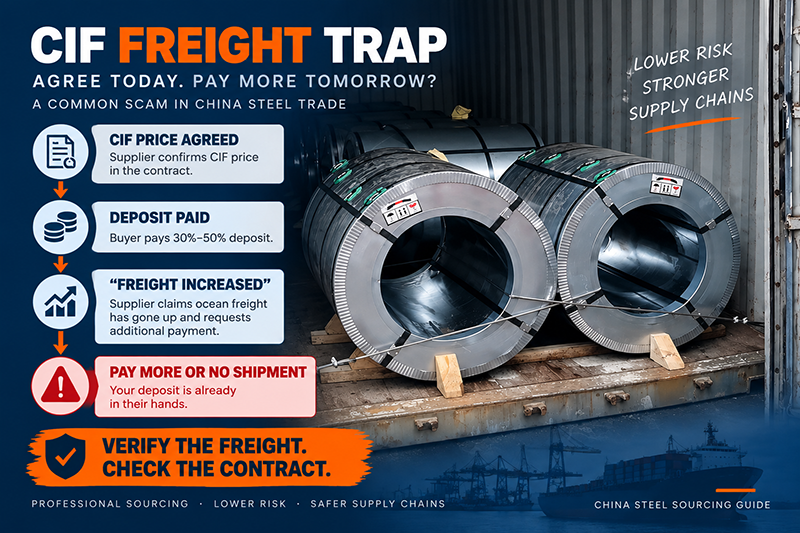
Pattern 3: Using “Rising Ocean Freight” to Demand Extra Payment on CIF Orders
This pattern deserves particular attention when purchasing steel under CIF terms.
The supplier initially offers an attractive CIF quotation
The contract is signed.
The buyer pays the deposit.
Then, shortly before shipment, the supplier suddenly announces:
“Ocean freight has increased significantly.”
The buyer is asked to pay an additional freight surcharge.
Sometimes the requested amount can be substantial.
If the buyer refuses, the supplier may say:
“We cannot ship unless you pay the additional freight.”
Or shipment is simply delayed indefinitely.
The buyer is now in a difficult position because a significant deposit has already been paid.
In some China steel scams, alleged freight increases are used only after the deposit has been paid, when the buyer has much less negotiating power.
Ocean Freight Really Can Increase — So How Do You Tell the Difference?
International freight rates do fluctuate.
Sometimes dramatically.
A legitimate supplier can genuinely suffer a loss if freight increases sharply after a fixed CIF quotation has been issued.
Therefore, a freight increase itself does not prove misconduct.
The important questions are:
What does the signed contract say?
Was the CIF price fixed?
Is there a freight-adjustment clause?
Was the quotation expressly subject to freight changes?
Can the supplier provide evidence of the original and revised freight rates?
Does the additional amount correspond to the actual increase?
Under a CIF transaction, the seller generally arranges and pays for carriage and insurance to the named destination port, subject to the contract and applicable Incoterms® rules.
A market increase in freight does not automatically mean that the seller can unilaterally rewrite an already agreed fixed price.
A Genuine Freight Increase Should Be Verifiable
Ask the supplier to provide:
- original freight quotation,
- revised freight quotation,
- freight forwarder or shipping line information,
- sailing schedule,
- container type,
- origin and destination ports,
- freight validity period,
- and a breakdown of the additional cost.
Be especially cautious if the only explanation is:
“Freight increased by USD 5,000. Please pay today.”
and no supporting documentation is provided.
The risk becomes considerably more serious when the supplier says:
“Pay the additional freight or we will not ship — and your deposit will not be refunded.”
At this point, the issue is no longer simply whether freight has increased.
The buyer should consider whether an already-paid deposit is being used as leverage to force an unagreed second payment.
A freight increase may be real. An unsupported demand for additional money is a different matter.
For greater protection, buyers may consider clearly defining freight-price treatment in the contract.
For example:
“The agreed CIF price is fixed and includes ocean freight and insurance to the named destination port. No additional freight surcharge shall be charged to the Buyer unless otherwise agreed in writing by both parties.”
If the parties want freight to remain adjustable, the adjustment mechanism should be written into the contract before the deposit is paid.
The Excuse May Change. The Leverage Is Always the Same.
This is one of the most important patterns for overseas buyers to understand.
After receiving the deposit, a problematic supplier may claim:
Raw material increased.
or:
Ocean freight increased.
or:
Production costs increased.
or:
The exchange rate changed.
The explanation changes.
But the leverage remains the same:
Your deposit is already in their hands.
The sequence often looks like this:
Deposit Paid
↓
Raw Material Increased / Freight Increased / Other New Cost
↓
Pay More
↓
Buyer Refuses
↓
No Production / No Shipment / No Refund
This is precisely why supplier verification and contract risk control should happen before the first payment.
Pattern 4: The Goods Arrive — but the Quantity Is Far Short
Another problem is serious short shipment.
For example:
Contract Quantity: 500 MT
but the actual delivered quantity may be substantially lower.
Short shipment may be hidden through:
- incorrect piece count,
- misleading theoretical weight,
- packaging differences,
- inaccurate loading data,
- or unclear contract wording.
This is why Loading Supervision can be just as important as product inspection.
Before the container is sealed or cargo leaves the port, verify:
Quantity · Actual Weight · Package Count · Dimensions · Container Number · Seal Number · Loading Process
Pattern 5: The Quantity Is Correct, but the Quality Is Not
The shipment may contain approximately the correct tonnage, but the material itself may fail to meet the contract.
Examples include:
Ordered: Q355 / Q345
Received: Material that does not meet the specified grade
Ordered: 8.0 mm
Received: Significantly thinner material
Ordered: Z275 Galvanized Steel
Received: Coating mass below the contractual requirement
Other problems may include:
- material substitution,
- excessive negative thickness tolerance,
- insufficient coating,
- severe rust,
- poor surface condition,
- unacceptable flatness,
- incorrect mechanical properties,
- incorrect chemical composition.
Once the goods arrive overseas, resolving these problems becomes much more expensive.
Inspection should happen before shipment, not after arrival.
Why a Business License Is Not Enough
One reason China steel scams can be difficult for overseas buyers to identify is that the company involved may be legally registered and appear completely legitimate on paper.
One of the most common mistakes in overseas sourcing is believing that a valid Chinese business license means the supplier is safe.
It does not.
A registered company can still have:
- limited operating assets,
- no factory,
- no production capacity,
- no stable mill relationship,
- weak financial capability,
- hidden controllers,
- or a management team completely different from the company‘s historical record.
A business license proves:
The legal entity exists.
It does not automatically prove:
Factory Ownership
Production Capacity
Inventory
Financial Strength
Fulfillment Capability
Quality-Control Capability
A stronger verification process should go further:
Company Verification
↓
Factory Verification
↓
Ownership & Controller Verification
↓
Bank Verification
↓
Contract Review
↓
Production Monitoring
↓
Pre-Shipment Inspection
↓
Loading Supervision
The objective is simple:
Discover the problem before your money or cargo is at risk.
What Should You Do If You Have Already Paid?
Failure to deliver does not automatically mean criminal fraud.
International trade disputes may involve contractual breach, quality disputes, commercial misconduct, payment disputes, or—in more serious circumstances—suspected fraud.
The legal classification depends on the facts and evidence.
However, buyers should act quickly if they discover patterns such as:
- the supplier disappears after payment;
- the factory was fabricated or misrepresented;
- certificates appear false;
- the receiving account is unrelated to the seller;
- the actual controller cannot be identified;
- multiple buyers report similar experiences;
- the goods are seriously different from the contract;
- funds appear to have been rapidly transferred;
- or the company refuses independent verification.
Immediately preserve evidence, including:
Sales Contract · PI · Commercial Invoice · Payment Records · Bank Details · Emails · WhatsApp Messages · WeChat Records · Website Screenshots · Registration Documents · Factory Evidence · Inspection Reports · Bill of Lading · Packing List · Shipping Records
Then consult a qualified lawyer familiar with Chinese commercial law and international trade disputes.
Depending on the facts, possible actions may include:
Negotiation · Arbitration · Civil Litigation · Asset Preservation · Criminal Reporting · Coordinated Legal Action
Speed matters.
Once funds are moved through multiple accounts or jurisdictions, recovery may become substantially more difficult.
Never Use Your Deposit to Test Whether a Supplier Is Trustworthy
Consider a steel order worth:
USD 300,000
with:
30% Deposit = USD 90,000
The buyer has already exposed USD 90,000 before production begins.
Compare this with the cost of:
- supplier verification,
- factory audit,
- ownership verification,
- bank verification,
- inspection,
- and loading supervision.
The cost of verification is usually only a very small fraction of the total transaction.
Never use a USD 90,000 deposit to verify whether a supplier is trustworthy.
Verification should happen before payment.
The Cheapest Steel Can Become the Most Expensive Steel You Ever Buy
Professional steel sourcing should not focus only on:
Who offers the lowest price?
The better question is:
Who can actually deliver the correct steel, in the correct quantity, at the agreed quality, price, and time?
When a quotation is dramatically below the rest of the market, do not immediately ask:
“Can you give me another USD 10 discount?”
First ask:
“Why are you able to offer this price?”
Then verify the answer.
Because:
A low price saves money only when the correct goods actually arrive.
If the steel never arrives, arrives short, arrives with the wrong specifications, or cannot be used, the “cheapest” supplier can quickly become the most expensive supplier you have ever chosen.
How to Protect Yourself from China Steel Scams: Final Checklist
Before sending a deposit, ask:
- Can I independently verify this company?
- Can I identify who actually controls it?
- Can I verify the factory or real supply chain?
- Is the quotation commercially reasonable?
- Does the bank beneficiary match the transaction?
- Are all technical specifications written into the contract?
- For CIF orders, does the contract clearly define how freight changes are handled?
- Is third-party inspection allowed?
- Can production progress be independently verified?
- Can loading be supervised?
- Is there a clear claim and dispute mechanism?
- Would I still trust this supplier if its quotation were not the cheapest?
If several answers are No, pause the transaction.
A legitimate supplier should not be afraid of reasonable verification.
The best protection against China steel scams is simple: verify the supplier before you pay.
WANDON / China Steel Sourcing Guide
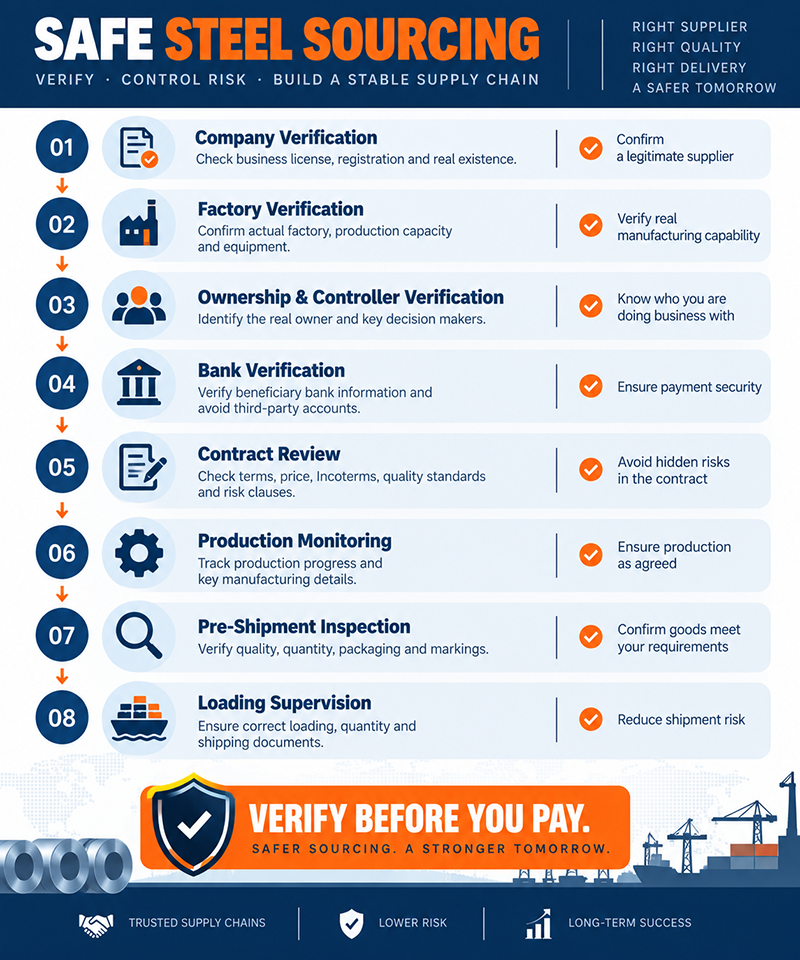
At WANDON Metal Industries and SinoAluZinc, we believe safe steel sourcing begins with transparency.
Our sourcing and risk-control services can include:
Metal Supply · Supplier Verification · Factory Audit · Product Inspection · Production Monitoring · Loading Supervision · Risk Control
Even if you purchase steel from another Chinese supplier, independent verification and inspection can help identify potential risks before payment and before shipment.