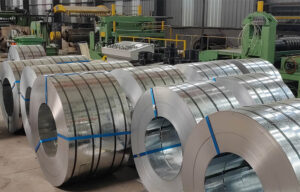
 Galvanized Coils (Sheets/Strips)
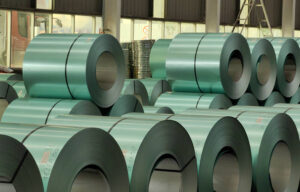 Galvalume Coils (Sheets/Strips)
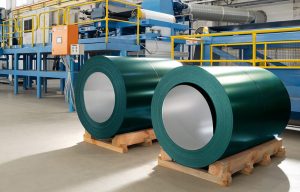 PPGI/PPGL Coils
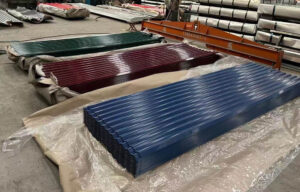 Corrugated Roofing sheets
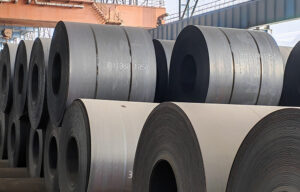 Hot Rolled Coils (Sheets/Strips)
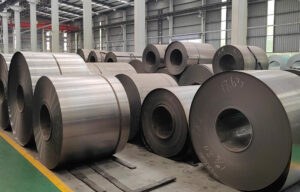 Cold Rolled Coils (Sheets/Strips)
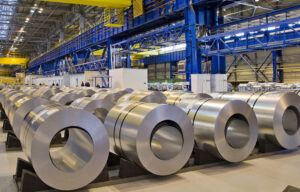 Aluminum Coils (Sheets)
 Tinplate Coils
A low steel price can cost far more than you expect — especially when missing cargo is followed by months of promises.
The vessel finally arrives after weeks of waiting. The containers are released, the trucks reach your warehouse, and your team starts unloading. It is the kind of situation every buyer fears when a steel sourcing scam goes undetected before shipment.
At first, everything looks normal. There are steel bundles, packing marks and shipping documents. But as the unloading continues, someone asks a simple question: “Is that all?”
You count the material again and compare it with the packing list. Then you check the invoice, the Bill of Lading and the contract. The answer doesn’t change.
You ordered 600 tons of steel. Only about 300 tons arrived.
This isn’t a normal weight tolerance or a small discrepancy. Half of the order is missing. And suddenly, the unusually low price that looked so attractive when you placed the order doesn’t look cheap anymore.
The Supplier Agrees to Compensate You
You contact the salesperson immediately. At first, the responses are predictable: there must be a mistake; they need to check with the factory; management is investigating.
You send photos, warehouse records, weight tickets and packing lists. After days or weeks of communication, the supplier finally acknowledges the shortage and agrees to compensate you.
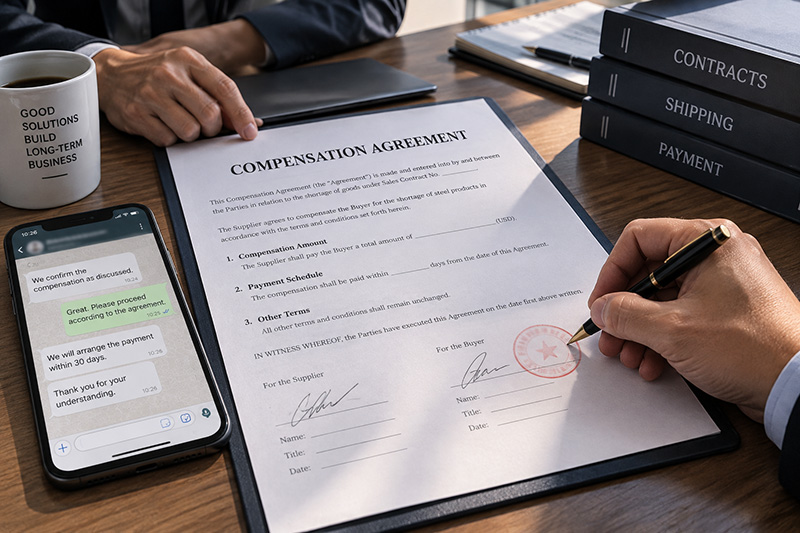
Then a formal Compensation Agreement arrives.
It contains the names of both companies, the amount owed, a repayment deadline, signatures and an official-looking company stamp. After all the arguments and uncertainty, this feels like progress. You finally have the supplier’s promise in writing.
So you wait.
When the deadline arrives, however, there is no payment.
The supplier explains that management has approved the refund but finance needs a few more days. A week later there is another explanation: the boss is travelling, the bank needs additional documents, there is a temporary cash-flow problem, or the payment will be arranged after the next holiday.
What makes the situation difficult is that the supplier may not disappear. They may continue answering your messages and apologizing. They may even issue another repayment schedule. Because communication continues, you still believe the problem might be resolved.
Three months become six. Six months can become a year.

Eventually, you realize that the compensation agreement did not necessarily solve the problem. It may simply have persuaded you to wait longer.
You lost steel in the first part of the transaction. During the second part, you may be losing something equally important: time.
Why Did the Buyer Accept Such a Low Price?
To understand how a buyer can end up in this situation, it helps to go back to the beginning.
Imagine receiving quotations from several Chinese steel suppliers. Most prices are relatively close, but one supplier is significantly cheaper.
You naturally ask why. Perhaps they say they have a special relationship with the mill, purchase huge volumes, operate on very low margins or have access to unusually cheap ocean freight. The salesperson communicates professionally, the company appears legitimate, the quotation looks formal and the contract carries a company stamp.
Eventually, the buyer thinks: Why should I pay more for the same steel?
Only after something goes wrong does the question change:
How could they sell the same steel so much cheaper than everyone else in the first place?
There are legitimate reasons why one supplier can be more competitive than another. A low price by itself is certainly not evidence of fraud. But when a quotation falls far below the normal market level, the price should be investigated rather than simply celebrated.
The same principle applies to freight. If several forwarders indicate that ocean freight is around one level while a supplier claims to have a dramatically lower rate, the buyer should understand how that rate is possible before relying on it.
An economically unreasonable price deserves additional verification.
A Compensation Agreement Is Not the Same as Compensation
Why would a dishonest supplier sign a compensation agreement if they did not intend to pay?
One possible reason is time.
An outright refusal to pay may cause a buyer to immediately investigate the company, contact lawyers, approach banks or begin formal recovery action. A written promise to compensate within 60 or 90 days can have the opposite effect: the buyer feels that the supplier has admitted responsibility and therefore agrees to wait.
This does not mean that compensation agreements are useless. A properly drafted agreement may be valuable evidence, and an acknowledgement of an outstanding obligation may assist in subsequent recovery proceedings.
But a signed document should never be confused with actual repayment.
For a substantial loss, the buyer should also be cautious about signing whatever document the supplier provides without understanding its legal implications. Whether a particular case involves an ordinary contractual dispute, fraud or other legal issues depends on the facts, evidence, intent and applicable law. Qualified legal advice may therefore be necessary much earlier than many buyers expect.
If a compensation agreement is proposed, verify the legal entity signing it. Is it the same company that signed the original contract, issued the invoice and received the payment? Does the company stamp belong to that entity? Is the person signing authorized to do so? Are the amount, currency, payment deadline and dispute-resolution provisions clearly defined?
Most importantly, don’t allow a new document to become a reason for another six months of passive waiting.
If the Cargo Is Already Missing, Preserve the Evidence
Once a serious shortage has been confirmed, communication with the salesperson should no longer be the buyer’s only response.
Preserve the contract, invoices, bank transfer records, packing lists, Bill of Lading, container and seal numbers, warehouse receiving records, weight tickets, inspection reports, unloading photographs and videos, emails and message histories. Keep copies of every admission, refund promise and compensation agreement.
Organize these records chronologically so that an independent third party can understand exactly what was ordered, what was paid for, what the supplier claimed to ship, what actually arrived and what the supplier subsequently admitted.
For a significant financial loss, professional advice on investigation and cross-border recovery should be considered early rather than after months of repeated promises.
But there is an even more important question.
Why Was the Missing Steel Not Discovered Before Shipment?
This is where prevention becomes much more valuable than recovery.
Steel is particularly suitable for independent quantity verification because much of it can be measured and calculated.
For H beams, I beams, angles and channels, the section size, length, quantity and theoretical unit weight can be cross-checked. For steel coils, individual coil numbers, weights, labels and quantities can be recorded. Pipes and plates can likewise be checked by dimensions, piece counts, theoretical weights and actual weighing records.
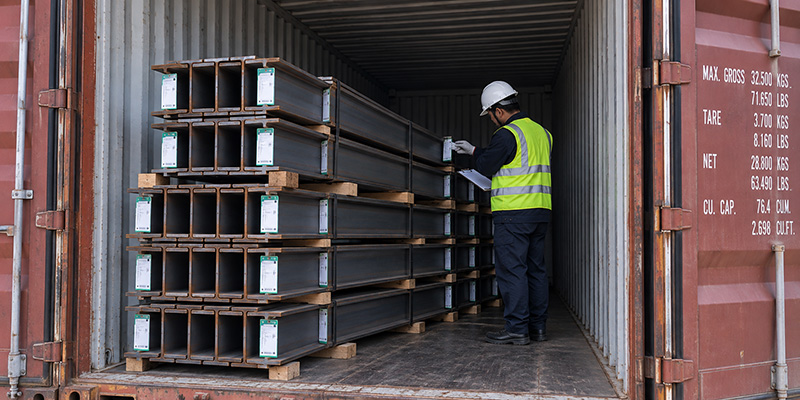
The objective is not complicated: compare the contract with the actual goods, compare the goods with the packing list, verify the quantity and weight, record what is loaded, and record the container and seal information.
A shortage of 300 tons should ideally be discovered at the factory or loading site in China — not weeks later at a warehouse thousands of kilometers away.
Don’t Let the Supplier Be Your Only Source of Evidence
In many international transactions, the supplier purchases or produces the steel, counts it, weighs it, prepares the packing list, arranges loading, takes the photographs and finally tells the buyer that everything is correct.
For established suppliers and routine transactions, buyers may be comfortable with that arrangement. But when dealing with a new supplier, a high-value order or an unusually low quotation, independent verification provides an additional layer of protection.
This does not mean assuming that every supplier is dishonest. It simply means that the party selling the goods does not have to be the buyer’s only source of information about those goods.
An independent party in China can verify the supplier before payment, inspect production and specifications, check quantity and weight before shipment, supervise loading and record the final container, seal and shipping information.
The cost of doing this is usually very small compared with the value of a large steel shipment.
The Most Expensive Steel May Start With the Cheapest Quotation
International buyers should negotiate. They should compare suppliers, freight rates and processing costs. Finding a more competitive source is part of good procurement.
But price needs to make commercial sense.
If four suppliers are quoting within a normal range and a fifth is dramatically cheaper, the right question isn’t simply “How much am I saving?”
It is “Why is this price possible?”
Which mill is supplying the steel? Can that relationship be verified? Does the material specification match the contract? Does the freight rate make sense? Is the company receiving the payment the same company named in the contract? Can the goods and their weight be independently checked before shipment?
Sometimes those questions confirm that the supplier genuinely has an advantage.
Sometimes they reveal that something doesn’t add up.
Either result is valuable before the money is sent.
Verify Before You Trust
If 600 tons were purchased and only 300 tons arrived, recovering the missing goods or money across borders can be slow, expensive and uncertain. A compensation agreement may help, but it cannot replace the value of identifying the problem before shipment.
That is the principle behind Wandon’s Safe Steel Sourcing services.
We help international buyers independently verify Chinese steel suppliers and shipments through supplier verification, factory audits, production monitoring, pre-shipment inspection, quantity and weight verification, loading supervision and sourcing risk control.
These services are also available when the steel is purchased from another Chinese supplier. You don’t need to buy the material from us for us to independently check the supplier or shipment.
The purpose is not to tell buyers whom to trust.
It is to give them enough independent information to make that decision themselves.
Verify before you trust — and verify the cargo before it leaves China.